The published record
PT-141 research: the central mechanism and the trials behind the approval
Mechanism, the pivotal Phase 3 program, mechanistic imaging, and the pharmacokinetics — each finding cited to its source.
The short version
PT-141 research splits into three layers. First, the mechanism: it switches on brain receptors (MC4R and MC3R) in circuits that govern sexual desire — a central effect, not a blood-flow one [1]. Second, the trials: two large Phase 3 studies in premenopausal women with low desire showed a small, real benefit, backed by a 52-week safety follow-up [3][4]. Third, the imaging: a brain-scan study showed the drug actually changes how the brain handles sexual cues [5].
The animal work came first and pointed the same way — erections in male animals and selective desire-driven behavior in female rats [1][2]. The pharmacokinetics (how the body handles a dose) are well mapped from the approved label: it acts fast and clears in a few hours [7]. Below, each layer is summarized with its source.
Mechanism: a central melanocortin agonist
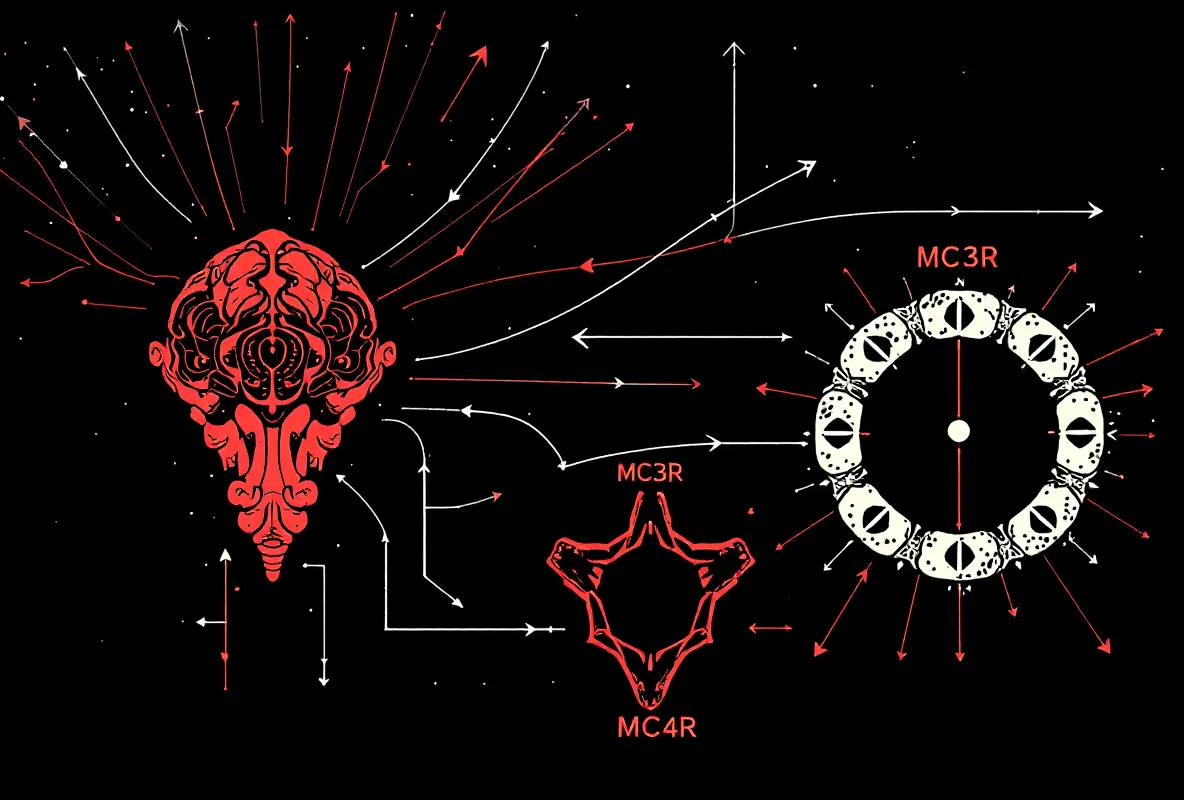
PT-141 (bremelanotide) is an agonist at melanocortin receptors, chiefly MC4R with secondary MC3R activity, concentrated in the hypothalamus and limbic system [1]. By stimulating MC4R in circuits such as the medial preoptic area — a hypothalamic region tied to sexual motivation — it is thought to engage dopamine signaling associated with appetitive (desire-driven) sexual behavior [1][2].
The defining contrast is with PDE-5 inhibitors, which act peripherally on vascular smooth muscle to improve blood flow. PT-141 works centrally, on the neural circuitry of sexual motivation [1]. The first preclinical pharmacology established this: systemic administration produced penile erections in rats and nonhuman primates and increased hypothalamic c-Fos (a marker of neuronal activation), and in men with erectile dysfunction it produced rapid, dose-dependent erectile activity [1]. PT-141 is the carboxylate derivative of melanotan-II, which biases it toward the sexual-function pathway [12].
The female-desire preclinical foundation
Before the human desire trials, the female-rat work established that melanocortin systems regulate desire specifically. PT-141 selectively stimulated appetitive solicitational sexual behavior — the proceptive, desire-driven behaviors — without affecting lordosis, pacing, or general motor activity [2]. It was described as the first pharmacological agent to act on appetitive female sexual behavior [2]. That selectivity (desire, not reflex or movement) is what made HSDD, a desire disorder, the rational human target.
A 2025 analysis in female Syrian hamsters adds nuance and a useful negative result: melanocortin-receptor mRNA was concentrated in ventral tegmental area dopamine neurons, but bremelanotide did not change that expression and did not enhance sexual reward (no conditioned place preference), suggesting it does not act on the VTA-NAc reward circuit [6]. The desire effect appears to be motivational, not reward-driven — a distinction the mechanism literature is still refining.
The pivotal Phase 3 program and mechanistic imaging
The human evidence centers on RECONNECT: two identical Phase 3 RCTs in 1,267 premenopausal women with HSDD. Bremelanotide 1.75 mg subcutaneous as-needed improved sexual desire (integrated FSFI-desire +0.35, P<.001) and reduced desire-related distress (FSDS-DAO item 13, -0.33, P<.001) over 24 weeks, meeting both coprimary endpoints [3]. The 52-week open-label extension (684 women) showed sustained benefit and a stable safety profile, with nausea (40.4%), flushing (20.6%), and headache (12.0%) the leading drug-related events [4].
The mechanistic capstone is a randomized, double-blind, placebo-controlled crossover fMRI study in 31 premenopausal women with HSDD: MC4R agonism increased sexual desire for up to 24 hours and altered task-based brain processing of erotic stimuli — enhancing amygdala-insula connectivity and cerebellar/supplementary-motor activity [5]. This is the clearest human evidence that the effect is central.
How long does PT-141 last
How long does PT-141 last comes down to two different clocks: how long the drug stays in the blood, and how long the desire effect persists. On the first, the US prescribing information gives a terminal half-life of about 2.7 hours (range 1.9-4.0 h) after subcutaneous injection, with median Tmax around 0.5-1.0 hour — it is absorbed and cleared within hours [7]. Early intranasal studies reported a similar half-life of about 1.85-2.09 hours [10].
The desire effect can outlast the drug in the blood. In the fMRI study, increased sexual desire was measurable for up to 24 hours after a single dose — longer than the molecule's plasma half-life, consistent with a downstream central effect rather than a moment-to-moment blood level [5]. So "how long it lasts" depends on which clock: hours in the bloodstream, up to about a day for the measured desire effect.
Pharmacokinetics and disposition
From the approved label and pharmacology: after subcutaneous dosing, bremelanotide has a volume of distribution of about 25.0 L, clearance about 6.5 L/hr, and roughly 21% serum protein binding [7]. It is metabolized by hydrolysis of the cyclic-peptide bonds and peptidase digestion, and excreted about 64.8% renally and 22.8% fecally from a radiolabeled dose [7]. The cyclic lactam structure gives it greater stability than linear melanocortin peptides [7]. The subcutaneous route is the approved one; the early intranasal form was discontinued for pharmacokinetic variability [10].